


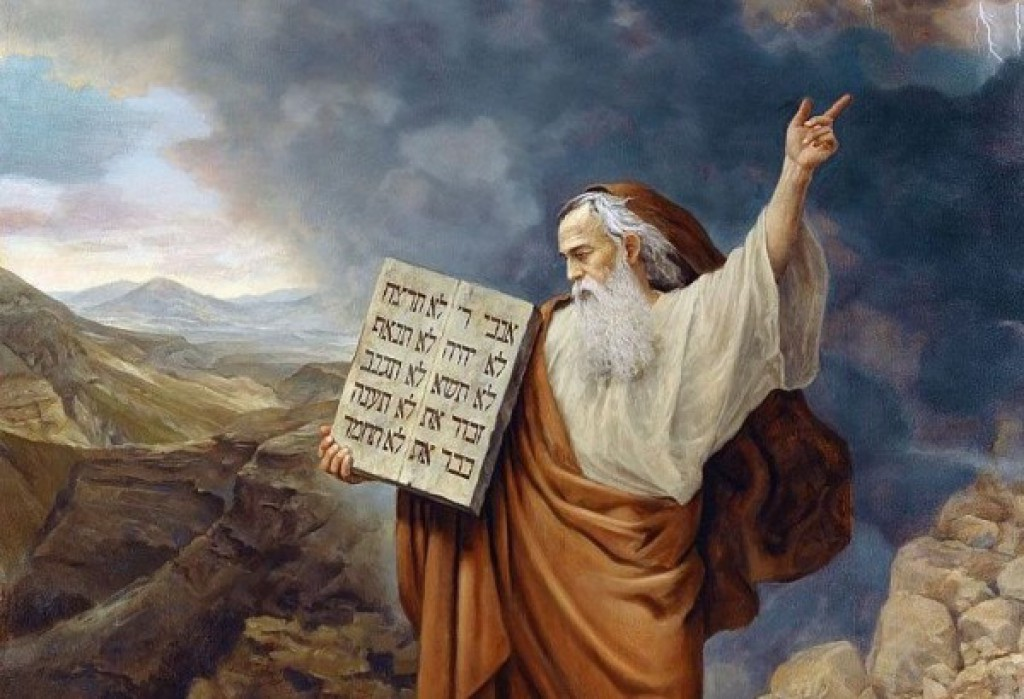
Of the 10 Old Testament commandments, the first 4 teach man love for God, while the remaining 6 teach love for neighbor; although these are closely interconnected.
To read the commentary on each Commandment ➡️ click on it...
- Laws of Nature and Morality
- Circumstances of the Emergence of the Ten Commandments
- Significance of the Ten Commandments
- 1. I am the Lord your God; you shall have no other gods before Me.
- 2. You shall not make for yourself an idol or any likeness of what is in heaven above, or on the earth beneath, or in the waters under the earth; you shall not bow down to them or serve them.
- 3. You shall not take the name of the Lord your God in vain.
- 4. Remember the Sabbath day, to keep it holy: six days you shall labor and do all your work, but the seventh day is a Sabbath to the Lord your God.
- 5. Honor your father and your mother, that your days may be prolonged in the land which the Lord your God gives you.
- 6. You shall not murder.
- 7. You shall not commit adultery.
- 8. You shall not steal.
- 9. You shall not bear false witness against your neighbor.
- 10. You shall not covet your neighbor’s wife, nor desire your neighbor’s house, nor his field, nor his male servant, nor his female servant… nor anything that belongs to your neighbor.
Source: Mysteries of Faith. Apologetic Notes / Bishop Alexander (Mileant).
_______________________________________
“Listen to God in the commandments, so that He may hear you in prayers.”
St. John Chrysostom“If God commanded something difficult and impossible, then someone might refer to the difficulty of His commandments; but if He commands something very easy, then what can we say when we do not care even about this? Can you not fast and preserve virginity? You can, if you wish, as those who fulfilled this convict us; but God did not use all strictness against us, did not command or order this, but left it to the will of the hearers; you can be chaste even in marriage, you can abstain from drunkenness. Can you not give away all your property? You can, as those who did this show, but God did not command even this, but ordered not to steal what belongs to others and to share from your own property with those in need. If someone says that he cannot be content with one wife, he deceives and deludes himself, in which those who preserve chastity even without a wife convict him. Can you not slander, can you not swear? On the contrary, it is more difficult to do this than not to do it. What justification do we have when we do not fulfill something so easy and convenient? We can present none.”
St. John Chrysostom“Let no one among us think: we go to the church of God, pray, making many prostrations, for this we will receive the Kingdom of Heaven. No; he will receive it who keeps the commandments of God.”
Venerable Theodore of Sanaksar“They often say: to be a Christian, one must fulfill Christ’s commandments. Of course; however, Christ’s commandments are not orders that He gives us: live this way, live that way, and if you do not live in this way, you will be punished for it… No, Christ’s commandments are His attempt to figuratively show us what we could be if we become and are a real, worthy person. Therefore, Christ’s commandment is not an order, but a revelation before our eyes of what we are called to be and can be; what we, consequently, must be.”
Metropolitan Anthony of Sourozh, “To Be a Christian”“Even if it is difficult to be a Christian, it is not because the Lord’s commandments are heavy, but only because the power of sin is great, the hereditary corruption of soul and body.”
Professor V.I. Eksemplyarsky“God in His Commandments commands to do something and not to do something else not because He ‘just wants it that way.’ Everything that God commanded to do is useful to us, and what He forbade is harmful.
Even an ordinary person who loves his child teaches him: ‘drink carrot juice – it is healthy, do not eat too many sweets – it is harmful.’ But the child does not like carrot juice, and he does not understand why it is harmful to eat many sweets: after all, sweets are sweet, and carrot juice is not. Therefore, he resists his father’s word, pushes away the glass of juice and throws a tantrum, demanding more sweets.
So also we, adult “children,” strive more for what gives us pleasure, and reject what does not correspond to our whims. And by rejecting the Word of the Heavenly Father, we commit sin.”
Archpriest Alexander Torik, “Churching.”“Why, when asked what commandments exist, 80% of baptized people answer without hesitation: ‘Do not kill, do not steal’? Why do they name specifically the sixth and eighth commandments of the Old Testament? Not the first, not the third, not the tenth?.. I thought about this for a long time and came to a curious conclusion: of all the commandments, a person chooses those for the fulfillment of which he needs to do nothing. ‘I did not kill, did not steal – I am a great guy, and leave me alone!’ And the seventh commandment ‘Do not commit adultery’ — do you know why it is skipped? It is a very ‘inconvenient’ commandment in our dissolute time. That is why a person deceives himself, choosing from God’s law only what is convenient for him, and consciously or unconsciously trampling on what prevents him from living his own way. Lawyers say that ignorance of the law does not exempt from responsibility. This is also true in relation to spiritual life, and precisely because knowledge (or ignorance) of the law depends entirely on us, on our good or bad will. …
By violating the commandments, a person does not even offend God. God is holy and cannot be mocked. But a person cripples his own life and the life of his loved ones, because the commandments are not some kind of shackles: they say, life is already hard, and here we still have to observe some commandments! No, it is not so. God’s commandments are precisely the conditions of normal, full, healthy, and joyful life for every person. And if a person violates these commandments, he harms, first of all, himself and his loved ones.”
Priest Dimitry Shishkin
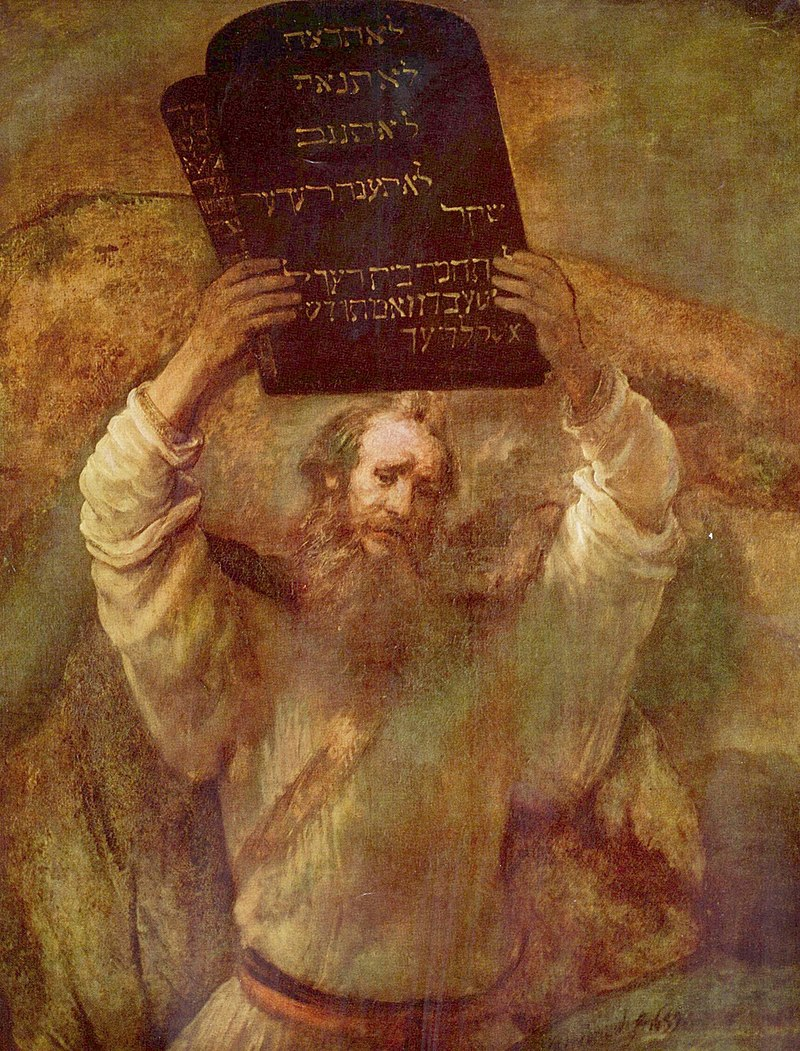
“Moses with the Tablets of the Law,” Rembrandt, 1659
Ten Commandments (God’s Law; Heb. עשרת הדברים, aseret ha-dvarim — lit. “ten statements”; Gr. δέκα λόγοι, dekalog — lit. “ten words”) — ten basic precepts that, according to the Pentateuch, were given by God Himself to Moses in the presence of the sons of Israel on Mount Sinai on the fiftieth day after the exodus from Egypt (Ex. 19:10–25). They form the basis of the Mosaic Law.
The Ten Commandments are contained in the Pentateuch in two slightly differing versions (see Ex. 20:2–17; Deut. 5:6–21). In another place (Ex. 34:14–26), part of the commandments is reproduced in the form of a commentary put into the mouth of the Most High, while the moral and ethical norms are not commented on, but prescriptions in the religious-cultic sphere are formulated. According to Jewish tradition, the version contained in chapter 20 of the Book of Exodus was on the first, broken tablets, and the version of Deuteronomy — on the second.
The circumstances in which God gave Moses and the sons of Israel the Ten Commandments are described in the Bible. Sinai stood in fire, enveloped in thick smoke; the earth trembled; thunder roared; lightning flashed; and in the noise of the raging elements, covering it, the voice of God resounded, pronouncing the commandments (Ex. 19:1 ff.). Then the Lord Himself inscribed the “Ten Words” on two stone tablets, the “Tablets of Testimony” (Ex. 24:12, 31:18, 32:16) or “Tablets of the Covenant” (Deut. 9:9, 11:15), and gave them to Moses. When Moses, after forty days on the mountain, descended with the tablets in his hands and saw that the people, forgetting God, were dancing around the Golden Calf, he became so terribly angry at the sight of the licentious feast that he smashed the tablets with God’s commandments against the rock. After the subsequent repentance of the entire people, God ordered Moses to hew out two new stone tablets and bring them to Him for a second writing of the Ten Commandments (Deut. 10:1–5).