

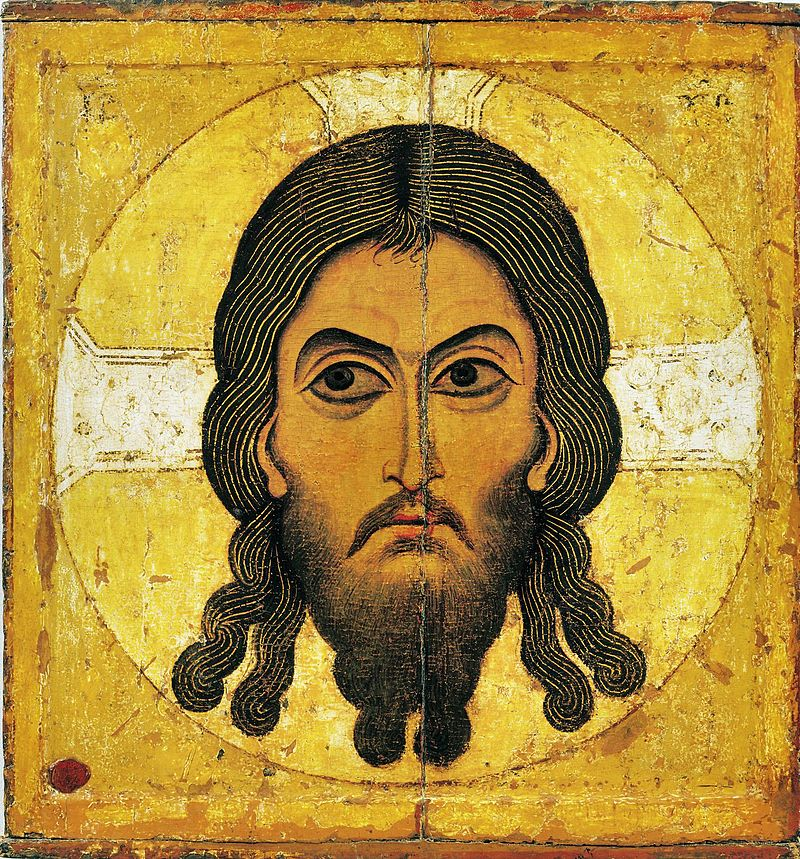
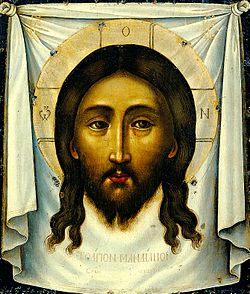
The Holy Mandylion or Image Not Made by Hands, Miraculous Mandylion (Άγιον Μανδήλιον from Greek μανδύη, μανδύας — “cloth, mantle, woolen cloak”) — a special type of depiction of Christ, representing the image of the face of Jesus Christ on a cloth (ubrus, or veil), or Ceramidion (from Greek κεραμιδιών — “tile”), representing the image of the face of Jesus Christ on a tile (clay board or ceramic tile).
The Image Not Made by Hands is an image that miraculously appeared without the participation of an artist, that is, created by God Himself.
There are two groups of traditions regarding the origin of the relic that served as the source of this iconography, each of which reports its origin not made by hands.

Eastern Tradition
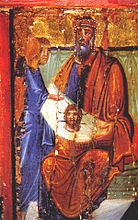
The Eastern tradition about the Image Not Made by Hands, which is more ancient, can be traced back to the first half of the 4th century. The story is connected with the sick king of Edessa (Mesopotamia, modern-day Şanlıurfa, Turkey) Abgar V Ukkama and the visit to him by Thaddaeus after the artist sent by him failed to depict Christ: Christ washed His face, wiped it with a cloth (ubrus), on which an imprint remained, and handed it to the artist. Since the beard was wet after washing with water, it imprinted in the form of a wedge-shaped strand, and therefore this image not made by hands is sometimes called “Savior with Wet Beard”. Thus, according to tradition, the Mandylion became the first icon in history. Eusebius of Caesarea in his Church History reports the following:
The story of Thaddaeus is as follows. The divinity of our Lord and Savior Jesus Christ, glorified among all people for its miraculous power, attracted multitudes of people even from foreign, very distant from Judea countries, who hoped for healing from diseases and various sufferings. Therefore, King Abgar, who gloriously ruled the peoples beyond the Euphrates, but tormented by an illness that human powers could not heal, having learned about the name of Jesus and His miracles — about which all bore witness — decided to implore Him, sending a messenger with a letter and a request for deliverance from the illness. The Savior did not heed his request at that time, but honored him with a special letter, in which He promised to send one of His disciples to heal his illness and at the same time save him and all his loved ones. This promise was soon fulfilled. After the Resurrection of Christ from the dead and the Ascension, Thomas, one of the twelve, by divine inspiration, sends Thaddaeus, who belonged to the number of the seventy disciples of Christ, to Edessa to preach the teaching of Christ. He fulfilled everything that our Savior had promised. Thaddaeus, having arrived at the place, heals Abgar with the word of Christ, and strikes all the local people with amazing miracles. Having sufficiently prepared them by his deeds and led them to the veneration of the power of Christ, he began to teach them the saving faith. And to this day, since then, all of Edessa has been sanctified by the name of Christ; it convincingly testifies to the mercies shown to it by our Savior.
Eusebius of Caesarea cites two documents-letters in confirmation, translated by him from Syriac and taken from the archives of Edessa: the request of the toparch Abgar and the answer of Jesus. Ephrem the Syrian also narrates about the correspondence of Abgar with Christ. In addition, the correspondence of Christ with Abgar and the narrative that the envoys of Abgar brought the image of the Savior from Jerusalem is included by the Armenian historian of the 5th century Moses Khorenatsi in the book “History of Armenia”: “This letter was brought by Anan, the messenger of Abgar (Avgar), together with the image of the face of the Savior (փրկչական պատկերին), which is kept in the city of Edessa to this day.” Evidence of Thaddaeus' visit to Abgar is provided by Procopius of Caesarea, narrating about the siege of Edessa by the Persian king Khosrow in his book “War with the Persians. War with the Vandals. Secret History,” he reports details of Abgar's illness: “having lived to a ripe old age, Abgar was subjected to a severe affliction of gout.” The historian Evagrius Scholasticus in his work “Ecclesiastical History” tells about the miraculous deliverance of the inhabitants of Edessa from the siege, they needed to burn the siege structure that Khosrow had built to capture Edessa, and they could not do it, then they resorted to the help of the Savior Not Made by Hands:
Completely at a loss in their thoughts, they bring the God-made image not made by hands, which Christ God sent to Abgar when he wished to see Him. Having brought this all-holy icon to the ditch they had dug, they sprinkled it with water and threw a few drops into the fire and onto the wood. The divine power immediately came to the aid of their faith and accomplished what they had previously been unable to do; the flame suddenly engulfed the wood and, faster than we can tell, turned it into coals, passed to the upper trees and consumed everything.
There are also apocryphal tales by unknown persons about this event: the Teaching of Addai the Apostle (5th–6th centuries) and a later Old Russian version of the legend about Abgar, a 13th-century manuscript. In addition, the testimony of Egeria’s “Pilgrimage to the Holy Places” has been preserved.
The linen cloth with the image of Christ was kept in Edessa for a long time as the most important treasure of the city. The history of the Image Not Made by Hands was set forth by Emperor Constantine VII Porphyrogenitus. According to his account, Abgar richly decorated the Image Not Made by Hands and placed it in a stone niche above the gates of Edessa so that everyone entering the city could venerate the holy image. But after some time, one of Abgar’s descendants, the ruler of Edessa, fell into idolatry; then, to protect the image from the madness of the pagans, it was walled up in the niche with tiles (bricks) and remained hidden for a long time until the invasion of the Persian army of Khosrow. During the war with the Persians, one night, Eulalius, the bishop of that Edessan city, had a vision of a radiant woman who said to him: “Above the city gates is hidden the not-made-by-hands image of Christ the Savior. Take it, and you will quickly deliver this city and its people from trouble.” And she showed him the place. The bishop, with great joy, as soon as it dawned, dismantled the enclosure and found the most pure not-made-by-hands image of Christ. On the brick that had been placed to preserve (the image), another image, indistinguishable from the first, was imprinted. Thus, two images appeared — one on the cloth, and the other on the tile (brick). During the iconoclastic period, John of Damascus referred to the Image Not Made by Hands. Pope Gregory II, when he learned of the beginning of iconoclasm in Constantinople in 730, wrote two letters to Emperor Leo the Isaurian, in which he exhorted the basileus to stop and cease the persecution of icons. In the first letter he writes about the Image Not Made by Hands as follows:
While Christ was in Jerusalem, Abgar, then the prince and ruler of Edessa, hearing of Christ’s miracles, wrote a letter to Him, and Christ sent him a handwritten reply and the holy glorious image of His Face. Go there for this Image Not Made by Hands and see. Multitudes of people from the East flock there and offer prayers.
In 787, the Seventh Ecumenical Council cited the existence of the Image Not Made by Hands as the most important testimony in favor of the veneration of icons.

In 944, the army of Emperor Romanos I Lekapenos surrounded the city; as a result of the siege, the inhabitants of Edessa, in exchange for peace (chrysobull), gave up the holy cloth, and the Image Not Made by Hands was solemnly transferred to Constantinople:
48. The inhabitants of Edessa, in which the precious image of Christ is kept, driven to despair by the Roman army besieging the city, sent envoys to Emperor Romanos and asked him to lift the siege, promising to give up the precious image of Christ. In exchange for this gift, they asked to return their prisoners from among the nobles, as well as to grant a chrysobull promising that the Roman army would cease devastating their land. And so it was done. When the holy image, or face of Christ, was already being brought to Constantinople, the patrician and parakoimomenos Theophanes went to the Sangarius River, where he met it with shining lamps, due honor, and hymns. And on the fifteenth of August Theophanes returned with it to the city, and the emperor, who was then in the Blachernae, knelt before the image. The next day, two imperial sons, Stephen and Constantine, the son-in-law Constantine together with Patriarch Theophylact, appeared at the Golden Gate. They raised it with due honor, brought it to the church of Holy Wisdom — ahead of the foot procession moved the entire synkletos and carried many lamps, and after veneration they carried it to the palace.
Since 15 (28) August is the feast of the Dormition of the Theotokos, the annual celebration for the Image Not Made by Hands was appointed for the next day — 16 (29) August; under this date the day entered the church calendar as a general church feast under the name “Transfer from Edessa to Constantinople of the Not-Made-by-Hands Image of Our Lord Jesus Christ”.
The shrine was stolen from Constantinople during the sack of the city by participants of the Fourth Crusade in 1204, after which it was lost (according to tradition, the ship carrying the icon was wrecked).
Some researchers consider the Mandylion from the church of San Silvestro in Capite, now located in the Santa Matilde Chapel in the Vatican, and the Mandylion kept since 1384 in the Armenian church of St. Bartholomew in Genoa to be the closest to the original image in the West. Both icons are painted on canvas, mounted on wooden bases, have the same format (approximately 29×40 cm) and are covered with a flat silver oklad cut along the contours of the head, beard, and hair. In addition, the appearance of the original relic may be attested by the wings of a triptych with the now lost central panel from the Monastery of St. Catherine on Sinai. According to the boldest hypotheses, the central panel was the “original” Holy Mandylion sent to Abgar.
Western Medieval Tradition
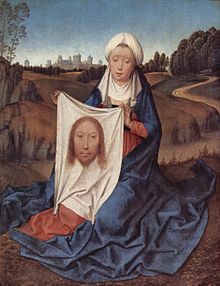
The Western version of the tradition arose, according to various sources, from the 13th to the 15th century, most likely among Franciscan monks. According to it, the pious Jewish woman Veronica, who accompanied Christ on His way to the Cross to Golgotha, gave Him a linen cloth so that Christ could wipe the blood and sweat from His face. The face of Jesus was imprinted on the cloth. The relic, called the “Veil of Veronica”, is kept in St. Peter’s Basilica in Rome. Presumably, the name Veronica when referring to the Image Not Made by Hands arose as a distortion of Latin vera icon (“true image”). A distinctive feature of the depictions of the “Veil of Veronica” from the “Savior with Wet Beard” is the crown of thorns on the Savior’s head, since it was imprinted on Veronica’s cloth during Jesus Christ carrying the cross. In medieval Western iconography, these two images were often confused.
In honor of the “Veil of Veronica”, a now-cancelled constellation was once named.
At least two “Veils of Veronica” are known: 1. in St. Peter’s Basilica in the Vatican and 2. the “Face of Manoppello”, also called the “Veil of Veronica”, but it has no crown of thorns. There is also no crown of thorns in Hans Memling’s painting “Saint Veronica”; apparently, not having a model, Hans Memling used a copy of the Savior Not Made by Hands instead of the Veil of Veronica.
Version of the connection of the image with the Shroud of Turin
There are theories linking the Not-Made-by-Hands Image of the Savior with another well-known pan-Christian relic — the Shroud of Turin. The Shroud is a full-length image of Christ on cloth. The cloth with the image of the Savior’s face exhibited in Edessa and Constantinople, according to the theories, could have been the Shroud folded several times; thus, the original icon may not have been lost during the Crusades, but taken to Europe and found in Turin. In addition, one of the variants of the Not-Made-by-Hands Image — “Savior Not Made by Hands — Do Not Weep for Me, Mother” (Christ in the Tomb) is traced by researchers to the Shroud as a historical prototype.
Liturgical Celebration in the Orthodox Church
The full name of the feast in the liturgical books of the Orthodox Church in honor of the Not-Made-by-Hands Image of Christ the Savior: Transfer from Edessa to Constantinople of the Not-Made-by-Hands Image of Our Lord Jesus Christ, that is, the Holy Cloth (Greek Μνήμη τῆς ἐξ Ἐδέσσης ἀνακομιδῆς τῆς ἀχειροποιήτου Εἰκόνος τοῦ Κυρίου ἡμῶν Ἰησοῦ Χριστοῦ, ἤτοι τοῦ Ἁγίου Μανδηλίου), is celebrated on 16 (29) August.
On the same day in the Orthodox Church the memory of the martyr Diomedes the physician is also celebrated, to whom prayers are offered for various ailments and diseases, as well as of the Feodorovskaya Icon of the Mother of God.
According to the Typikon, the feast in honor of the Cloth belongs to minor feasts “with doxology”, but in the Russian tradition a vigil is usually served. It coincides with the first day of the afterfeast of the Dormition of the Theotokos; for this reason, both services are combined at the divine service. The canon of the feast was written by Patriarch Germanus. The acrostic of the canon: I venerate the sight of Thy imprinted image, O Savior (Ancient Greek Σῆσφραγίσμα Σώτερ ὄψεως σέβω)
Troparion in honor of the Not-Made-by-Hands Image of Christ the Savior.
| In Greek | In Church Slavonic |
|---|---|
| Τὴν ἄχραντον Εἰκόνα σου, προσκυνοῦμεν ἀγαθέ, αἰτούμενοι συγχώρησιν τῶν πταισμάτων ἡμῶν, Χριστὲ ὁ Θεός· βουλήσει γὰρ ηὐδόκησας σαρκί, ἀνελθεῖν ἐν τῷ Σταυρῷ, ἵνα ῥύσῃ οὓς ἔπλασας, ἐκ τῆς δουλείας τοῦ ἐχθροῦ· ὅθεν εὐχαρίστως βοῶμέν σοι· Χαρά ἐπλήρωσας τὰ πάντα, ὁ Σωτὴρ ἡμῶν, παραγενόμενος εἰς τὸ σῶσαι τὸν κόσμον. | Пречи́стому Твоему́ о́бразу покланя́емся, Благи́й, прося́ще проще́ния прегреше́ний на́ших, Христе́ Бо́же: во́лею бо благоволи́л еси́ пло́тию взы́ти на кре́ст, да изба́виши я́же созда́л еси́ от рабо́ты вра́жия. Те́мже благода́рственно вопие́м Ти: ра́дости испо́лнил еси́ вся, Спа́се наш, прише́дый спасти́ мир. |
The troparion to the Not-Made-by-Hands Image of the Savior, besides the August feast, is very widely used in divine services: for example, on the first Sunday of Great Lent; it is also used in the rite of the Liturgy during the entrance prayers for the clergy to venerate the icon in the iconostasis, in the rite of consecration of a Lord’s icon according to the Trebnik, as part of the 6th Hour on weekdays of Great Lent, and in the Octoechos — as the sedalen of the 2nd tone on Friday.
Icon of the Savior Not Made by Hands in Russian Painting
First Samples. Beginning of the Russian Tradition
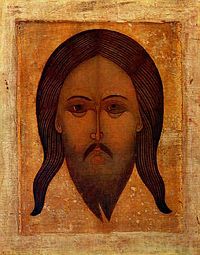
Icons of the Savior Not Made by Hands reached Rus', according to some sources, already in the 9th century. The oldest surviving icon of this iconographic type is the Novgorod Savior Not Made by Hands (second half of the 12th century). The following iconographic types of the Not-Made-by-Hands Image can be distinguished: “Savior on the Cloth” or simply “Cloth”, where the face of Christ is placed on the depiction of a light-colored cloth (ubrus), and “Savior on the Tile” or simply “Tile” (in the sense of “ceramic tile”, “brick”), “Ceramide”. According to tradition, the image of Christ appeared on the tiles or bricks that concealed the niche with the icon of the Savior Not Made by Hands. Occasionally on this type of icon the background is a depiction of brick or tile masonry; more often the background is simply a darker color (compared to the cloth).
Variants
The most ancient depictions were made on a plain background, without any hint of fabric or tile. The depiction of an even rectangular or slightly curved cloth as a background already appears on the fresco of the Church of the Savior on Nereditsa (Novgorod) at the end of the 12th century. The cloth with folds begins to spread from the second half of the 13th century, first in Byzantine and South Slavic icon painting, on Russian icons — from the 14th century. From the 15th century, the draped cloth can be held at the upper ends by two angels. In addition, various variants of the icon “Savior Not Made by Hands with Deeds” are known, when the image of Christ in the center of the icon is surrounded by panels with the history of the image. From the end of the 17th century, under the influence of Catholic painting, depictions of Christ with a crown of thorns on the cloth appear in Russian icon painting, that is, in the iconography of the “Veil of Veronica”. Depictions of the Savior with a wedge-shaped beard (tapering to one or two narrow ends) are also known in Byzantine sources; however, only on Russian soil did they develop into a separate iconographic type and receive the name “Savior with Wet Beard”.
In the collection of the State Museum of Fine Arts of Georgia there is an encaustic icon of the 7th century called the “Ancha Savior”, depicting Christ half-length and considered the “original” Edessan icon.
The Christian tradition regards the Not-Made-by-Hands Image of Christ as one of the proofs of the truth of the incarnation of the second person of the Trinity in human form, and in a narrower sense — as the most important testimony in favor of the veneration of icons.
According to tradition, the icon “Savior Not Made by Hands” is the first independent image that an icon painter who has completed apprenticeship is entrusted to paint.
Various Depictions of the Savior Not Made by Hands


Vyatka Savior Not Made by Hands
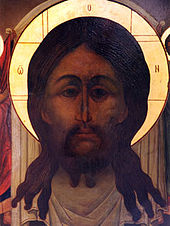

In the middle of the 17th century, an epidemic of plague swept through the central regions of the Russian state, especially affecting Moscow. One of the cities, Khlynov, was spared by the epidemic, and rumors began to spread that the reason for this was the miraculous image of the Savior Not Made by Hands, to whom the townspeople prayed. Having learned of this, Tsar Alexis Mikhailovich ordered the icon to be brought to Moscow. The image was delivered in procession in 1648.
The icon itself was left in the Moscow Novospassky Monastery in 1647. An exact copy was sent to Khlynov, and another was painted above the gates of the Frolov Tower. In honor of the image of the Savior and the fresco of the Smolensk Savior on the outside of the gate through which the icon was brought, both the gate and the tower were named Savior Gates. In 1839, the original icon was adorned with a silver-gilt riza with precious stones in place of the one stolen by the French in 1812.
A distinctive feature of the Vyatka Savior Not Made by Hands is the depiction of angels standing on the sides, whose figures are not fully painted. The angels do not stand on clouds but seem to hover in the air. One can also distinguish peculiar features of Christ’s face. On the vertically hanging cloth with wavy folds, a slightly elongated face with a high forehead is depicted frontally. It is inscribed in the plane of the icon board so that the large eyes, endowed with great expressiveness, become the center of the composition. Christ’s gaze is directed straight at the viewer, the eyebrows are highly raised. Luxuriant hair falls in long, flying strands, three on each side. The short beard is divided into two parts. Strands of hair and beard extend beyond the circle of the nimbus. The eyes are painted lightly and transparently; their gaze possesses the attractiveness of a real gaze. Christ’s face expresses calmness, mercy, and meekness.
After 1917, the original icon in the Novospassky Monastery and the copy above the Savior Gates were lost. Now the monastery keeps a 19th-century copy, which occupies the place of the original in the iconostasis of the Transfiguration Cathedral. The copy left in Vyatka was kept until 1929, after which it was also lost.
In June 2010, with the help of Galina Alekseevna Mokhova, a researcher at the Vyatka Art Museum, it was established exactly what the miraculous Vyatka icon looked like; after that, a new exact copy of the Savior Not Made by Hands was painted and at the end of August sent to Kirov (Vyatka) for installation in the Savior Cathedral.
Kharkiv Savior Not Made by Hands

A miraculous icon in the Byzantine style, dated to the 18th century, was long kept in the Kharkiv diocese. It miraculously renewed itself instantaneously in the presence of witnesses at the Borisoglebsk Monastery in 1997.
Image of the Savior Not Made by Hands in the Transfiguration Cathedral of St. Petersburg
The miraculous image of the Savior Not Made by Hands is located on the analogion near the right kliros. It is closely connected with the life of Emperor Peter the Great and was his favorite image. This same image today is the main icon of the Armed Forces of Russia.
Painted by the famous Moscow painter Simon Ushakov for Tsar Alexis Mikhailovich, the image of the Savior passed to Peter I from his mother. The image was with the emperor both at the founding of St. Petersburg and at the Battle of Poltava. Peter always took the icon with him on military campaigns. This icon more than once saved the tsar’s life.
Later the image was placed in Peter I’s cottage on the Petersburg side, in the dining room turned into a chapel. When the chapel was closed in 1930, the venerated image was transferred to the Trinity Church on Stremyannaya Street, and in 1938 — to the Transfiguration Cathedral.
Other Information
Emperor of All Russia Alexander III had a copy of the ancient miraculous icon of the Savior Not Made by Hands with him during the train wreck near Kharkiv at Borki station in 1888. After the miraculous rescue, by decree of the Holy Synod, a special moleben in honor of the miraculous image of the Savior Not Made by Hands was composed and published.