

Qumran Manuscripts, or Dead Sea Scrolls
— the name of manuscripts discovered, starting from 1947, in the caves of Qumran, in the caves of Wadi Murabba'at (south of Qumran), in Khirbet Mird (southwest of Qumran), as well as in a number of other caves of the Judean Desert and in Masada. The scrolls found in Qumran date from the 3rd century BCE to the 1st century CE and have enormous historical, religious, and linguistic significance. The study of the manuscripts confirmed that at least some of them were written precisely in the Qumran community.
In the area of the Dead Sea, a large number of written fragments with a small amount of text were discovered, which are the remains of large manuscripts that became unusable due to natural causes or human intervention. According to Jewish customs prohibiting the destruction of the Torah and sacred texts, unusable scrolls were preserved in a genizah. Several well-preserved scrolls were found intact, including the Dead Sea Scrolls. Researchers collected a collection of 981 manuscripts found in 1946–1947 and 1956 in 11 different caves. The 11 Qumran caves are located in the vicinity of Hellenistic period settlements at Khirbet Qumran. Bronze coins found in the same places date from the time of John Hyrcanus (135–104 BCE) to the First Jewish War (66–73 CE).
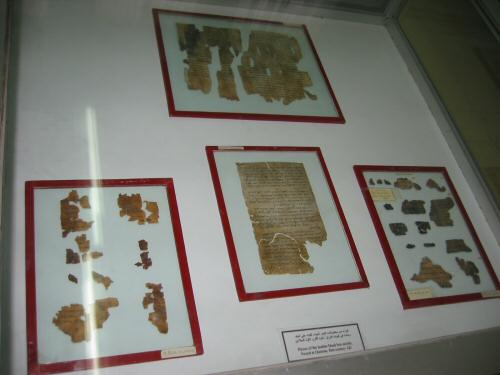
Fragments of the Dead Sea Scrolls on display at the Archaeological Museum in Amman
Discovery
The very first finds were discovered by local Bedouin shepherds Muhammad edh-Dhib, his brother Juma Muhammad, and Khalil Musa between November 1946 and February 1947. The shepherds found 7 scrolls in jars in an inaccessible cave. Archaeologist John Trever reconstructed the history of the find after several interviews with the shepherds. Juma Muhammad was the first to notice the cave; they agreed to return there in three days. Muhammad edh-Dhib returned the next day and was the first to enter the cave, now known as “Cave 1.” He took out several scrolls (Trever determined that they were the Great Isaiah Scroll 1QIsaa (English), Habakkuk Commentary 1QpHab (English), Community Rule 1QS (English)) and took them to show to his family. For some time the Bedouin kept the scrolls in a tent, showing them to those around him. After some time, the Community Rule Scroll broke into two parts. Then the Bedouin took the scrolls to a merchant named Ibrahim Ijha in Bethlehem. He returned them as worthless, deciding they had been stolen from a synagogue. Then the Bedouin went to the nearest market, where a Syrian Christian wanted to buy the scrolls. A sheikh intervened in their conversation and suggested taking them to the antiquarian Khalil Eskander Shahin, known as “Kando.” The scrolls were sold for 7 Jordanian pounds (about $28, equivalent to $314 in 2018). Then Kando sold the scrolls to the metropolitan and archbishop of the Syriac Orthodox Church, known as Mar Samuel (English), who was engaged in verifying their authenticity.
In early 1949, Mar Samuel brought the scrolls to the USA, where they were sold for $250,000 to Yigael Yadin, who returned them to Israel in 1954. Now the scrolls are kept in the so-called Shrine of the Book in Jerusalem, and their digital copy can be studied on the Israel Museum website — http://dss.collections.imj.org.il/.
For the first two years after the initial discovery, scholars could not locate Cave 1. During this time, the Arab-Israeli War was going on, which did not allow large-scale searches. Cave 1 was rediscovered on January 28, 1949, by Belgian UN observer Captain Philippe Lippens and Arab Legion Captain Akkash el-Zebn. Excavations of Cave 1 were conducted from February 15 to March 5, 1949, by the Jordanian Department of Antiquities under the leadership of Gerald Lancaster Harding (English) and Roland de Vaux (English). In Cave 1, fragments of the Dead Sea Scrolls, linen fabrics, and other artifacts were discovered.
In 1951, Roland de Vaux and his team began a full-scale investigation of Qumran. In February 1952, Bedouins found 30 fragments in a cave now called Cave 2. Subsequently, 300 fragments from 33 manuscripts were found in Cave 2, including the Book of Jubilees and the Book of the Wisdom of Jesus Son of Sirach in Hebrew.
A month later, on March 14, 1952, Cave 3 was discovered with fragments of the Book of Jubilees and the Copper Scroll. Between September and December 1952, Caves 4, 5, and 6 were discovered. In Cave 4, in particular, fragments of the Book of Tobit were found. As the historical value grew, so did the cost of the scrolls, so both Bedouins and scholars accelerated the search. Between 1953 and 1956, Roland de Vaux conducted four more expeditions and found a large number of scrolls and artifacts. In 1955, Cave 7 was found, in which the Epistle of Jeremiah was discovered. The last fragments were found in Cave 11, discovered in 1956. In this cave, the last Psalm 151 was found.
In February 2017, archaeologists from the Hebrew University announced the discovery of Cave 12. Only an empty parchment in a jar was found in it, but empty and broken jars possibly indicate that the cave was discovered and looted.
The archive of spectral and infrared images of all manuscripts can be viewed on the Leon Levy Foundation website
Description
In terms of content, the Qumran manuscripts can be divided into three groups: biblical texts (about 29% of the total number of manuscripts), apocrypha and pseudepigrapha, as well as the literature of the Qumran community.
The main writing material is parchment from goat or sheep skin, occasionally papyrus; some manuscripts were made by embossing on copper sheets; for the latter, later rolled into scrolls for packing in jars, a special device had to be constructed for cutting into fragments, since due to inevitable corrosion, unrolling the scroll threatened its complete destruction. Ink — carbon (with the sole exception of the apocryphal Book of Genesis).
The Qumran scrolls are written mainly in ancient Hebrew, partially in Aramaic; fragments of Greek translations of biblical texts are also found. The Hebrew of non-biblical texts was the literary language of the Second Temple period; some fragments are written in post-biblical Hebrew. The square Hebrew script, the direct predecessor of the modern printed script, is mainly used.
Paleographic data, external evidence, as well as radiocarbon analysis allow dating the main body of these manuscripts to the period from 250 BCE to 68 CE (the late Second Temple period) and considering them as the remains of the library of the Qumran community.
List of Books and Fragments
Cave 1
“Book of the Prophet Isaiah” (1QIsaa, 1QIsab), “Community Rule” (1QS), Pesher on “Habakkuk” (1QpHab), “War Scroll” (1QM), “Thanksgiving Hymns” (1QHa and 1QHb), “Apocryphon of Genesis” in Aramaic (1QapGen), “Testament of Levi” (CTLevi), “Book of Genesis” (1QGen), “Exodus” (1QExod), “Book of Leviticus” and “Book of Numbers” (1QpaleoLev), “Deuteronomy” (1QDeuta, 1QDeutb), “Book of Judges” (1QJudg), “Book of Samuel” (1QSam), “Book of the Prophet Ezekiel” (1QEzek), “Psalter” (1QPsa, 1QPsb, 1QPsc), Phylacteries (1QPhyl), Pesher on “Book of the Prophet Micah” (1QpMic), Pesher on “Book of the Prophet Zephaniah” (1QpZeph), Pesher on “Psalter” (1QpPs), “Book of Jubilees” (1QJuba, 1QJubb), “Book of Noah” (1QNoah), Fragments of Apocryphon of Genesis (1QapGen), “Testament of Levi” (1QTLevi/1QALD), “Words of Moses” (1QDM), “Book of Giants” (1QEnGiantsa, 1QEnGiantsb), “Apocryphal Prophecy” (1Q Apocr.Prophecy), “Instruction” (1Q Instruction), “Book of Mysteries” (1QMyst), “Rules of the Congregation” (1QSa) and “Rules of Prayer” (1QSb), “Apocryphon of Moses” (1QapocrMoses B), “Liturgical Texts” (1Q30, 1Q31), “New Jerusalem” in Aramaic (1QNJ), “Liturgical Prayers” and “Festival Prayers” (1QPrFetes / 1QLitPr), “Hymns” (1Q36 — 1Q40), “Book of Daniel” (1QDana and 1QDanb), as well as unclassified fragments 1Q41–1Q70.
Cave 2
“Genesis” (2QGen), “Exodus” (2QExoda, 2QExodb, 2QExodc), “Book of Leviticus” (2QpaleoLev), “Book of Numbers” (2QNuma, 2QNumb, 2QNumc), “Deuteronomy” (2QDeuta, 2QDeutb, 2QDeutc), “Book of the Prophet Jeremiah” (2QJer), “Psalms” (2QPs), “Book of Job” (2QJob), “Book of Ruth” (2QRutha, 2QRuthb), “Book of the Wisdom of Jesus Son of Sirach” (2QSir), “Book of Jubilees” (2QJuba, 2QJubb), “Apocryphon of Moses” (2QapMoses), “Apocryphon of David” (2QapDavid), “Apocryphal Prophecy” (2QapProph), “New Jerusalem” (2QNJ), “Juridical Text” (2Q Juridical Text), “Book of Giants” from Enoch (2QEnGiants), as well as unidentified texts (2Q27 — 2Q33) and debris (2QX1).
Language of the Qumran Manuscripts
Texts created by the members of the Qumran community themselves play a huge role in the study of the history of the Hebrew language. The most important of this group are:
- “Rule” (1QSa),
- “Blessings” (1QSb),
- “Hymns” (1QH),
- “Commentary on Habakkuk” (1QpHab),
- “War Scroll” (1QM) and
- “Temple Scroll” (11QT).
The language of the “Copper Scroll” (3QTr) differs from the language of these documents and can be attributed to the spoken language of that time, the predecessor of Mishnaic Hebrew.
The language of the other documents created by the community members, on the one hand, shows closeness to early biblical Hebrew in vocabulary. On the other hand, features common to late biblical Hebrew and Mishnaic Hebrew are absent in the language of the Qumran manuscripts (Qumran Hebrew). On this basis, scholars suggest that the members of the Qumran community consciously avoided in written and possibly spoken language the tendencies characteristic of the spoken language of that time, such as, for example, the increased influence of Aramaic dialects. To shield themselves from the outside world, the community members used terminology based on biblical expressions, thereby symbolizing a return to the “pure” religion of the Exodus generation.
Thus, Qumran Hebrew is not a transitional link between late biblical and Mishnaic Hebrew, but represents a separate branch in the development of the language.
Qumran Calendar Texts
There are about twenty different texts from Qumran that describe a 364-day solar calendar. They are mostly very fragmentary. However, they differ significantly from the Babylonian lunar calendar, which developed into the 354-day Jewish calendar. The calendar year was divided into four quarters. Holidays were oriented toward the solar year and fell on different days than those indicated in the Babylonian calendar. Many texts containing weekly schedules of temple service for twenty-four priestly families are known as Mishmarot.
Mishmarot
Mishmarot contains weekly schedules of temple service for twenty-four priestly families who performed duties in the temple. The order of the families is described in 1 Chronicles 24:7–18. Over six years, it completes a full cycle of repetition, and a new cycle begins the following year with the first priestly family.
Here are a few entries in 4Q325 (“Mishmarot D”):
- The beginning of the second month — this is the sixth [day] of the course of Jedaiah. On the second day of the month — Sabbath during the course of Harim
As the years pass, Sabbaths and festivals are usually noted. For example (from 4Q326):
- [… evening of the fourteenth day of the month] — Feast of Unleavened Bread. On the fourth day of the week — holy convocation. On the twenty-fifth day of the month] Sabbath. On the twenty-sixth day of the month — Festival of B[arley]
The texts are quite fragmentary, but since most of the material is formulaic, they can be relatively easily reconstructed.
One of these texts, the extremely fragmentary Mishmarot C (4Q322–324b), also contains a number of historical allusions mentioning the names “Yohanan” (possibly John Hyrcanus) and Shelomzion (Salome Alexandra). Ghostly fragments of the text read: “Shelomzion entered…” and “Hyrcanus rebelled…” (presumably Hyrcanus II, who rebelled against his brother Aristobulus II). Another fragment twice mentions “Aemilius killed…” — Aemilius Scaurus (one of Pompey’s lieutenants in Judea in 63 BCE).
Other Texts
Among the calendar works there is 4Q317, which indicates the phases of the Moon in relation to the 364-day calendar, 4Q318 (“Brontologion”), which contains a section in which thunder (Ancient Greek brontos) was used to predict the future, and 4Q319 (otot or “signs”), which analyzes certain events over 294 years, that is, six cycles.
Publication of Texts
Documents found in Qumran and other areas are published in the series “Discoveries in the Judaean Desert” (DJD), which currently numbers 40 volumes published since 1955 by Oxford University Press. The first 8 volumes were written in French, the rest in English. The main editors of the publication were R. de Vaux (volumes I–V), P. Benoit (volumes VI–VII), E. Tov (volumes IX–XXXIX), and others.
Publications of documents contain the following components:
- General introduction describing bibliographic data, physical description including fragment size, material, list of features such as errors and corrections, orthography, morphology, paleography, and dating of the document. For biblical texts, a list of variant readings is also provided.
- Transcription of the text. Physically lost elements — words or letters — are given in square brackets.
- Translation (for non-biblical works).
- Notes concerning difficult or alternative readings.
- Photographs of fragments, sometimes infrared, usually at 1:1 scale.
Volume XXXIX of the series contains an annotated list of all previously published texts. Some documents were preliminarily published in scientific journals devoted to biblical studies.
In the early 1990s, the publisher of the journal “Biblical Archaeology Review” Hershel Shanks, with the help of California professors R. Eisenman and D. Robinson, published unpublished fragments of manuscripts from the “Discoveries in the Judaean Desert” series in the two-volume “A Facsimile Edition of the Dead Sea Scrolls.” In his edition, Shanks also included a fragment of manuscripts under catalog number 4QMMT, which was reconstructed by Professor Elisha Qimron of the Hebrew University of Jerusalem.
In September 2011, the Israel Museum, in collaboration with Google, digitized five scrolls — the Temple Scroll, the Great Isaiah Scroll, the Community Rule Scroll, the War Scroll, the Commentary on the Book of the Prophet Habakkuk — and made them freely available on the Internet.
At the end of 2012, about 5,000 high-resolution photos were published by the same Google and the Israel Museum. Currently, these annotated photos of fragments of more than 1,200 manuscripts are available on the Dead Sea Scrolls Electronic Library website under the auspices of the Israel Antiquities Authority (the site is available in Russian, Hebrew, English, and other languages).
Table of the Most Represented Books
Below are listed the most represented books of the Bible and apocrypha among the Dead Sea Scrolls, by the number of found translatable fragments:
| Book | Number of Finds |
|---|---|
| Psalms | 39 |
| Book of Deuteronomy | 33 |
| Book of Enoch | 25 |
| Book of Genesis | 24 |
| Book of the Prophet Isaiah | 22 |
| Book of Jubilees | 21 |
| Book of Exodus | 18 |
| Book of Leviticus | 17 |
| Book of Numbers | 11 |
Two of them, the Book of Enoch and the Book of Jubilees, are apocryphal books.
Significance for Biblical Studies
Between 1947 and 1956, more than 190 biblical scrolls were discovered in eleven Qumran caves. These are mainly small fragments of Old Testament books. In 2008, one fragment of the Book of Nehemiah was found. The only book of the Hebrew Bible for which no manuscript fragments have been identified is the Book of Esther. Also found was one complete text of the Book of Isaiah — 1QIsaa. Among the non-canonical or deuterocanonical books and additions to the Old Testament in Qumran, fragments of the Book of Tobit, Wisdom of Jesus Son of Sirach, Epistle of Jeremiah, and Psalm 151 were discovered. In addition to biblical texts, valuable information is also contained in quotations from non-biblical texts, for example, pesharim.
According to Emanuel Tov (1992), from the point of view of their textual status, Qumran texts belong to five different groups, four of which (1, 3, 4, 5) were unknown before the Qumran discoveries:
- Texts written in accordance with Qumran practice. These texts are distinguished by a special orthographic style, characterized by the addition of numerous matres lectionis facilitating text reading. They make up about 25% of Qumran biblical scrolls.
- Proto-Masoretic texts. These texts are close to the modern Masoretic Text and make up about 40% of all Qumran biblical texts.
- Pre-Samaritan (pre-Samaritan or harmonizing) texts. These texts show similarity to the later Samaritan Pentateuch. Apparently, one of the texts of this group became the basis for the Samaritan Pentateuch, and Samaritan ideological changes and phonological features were introduced later into this text. These texts make up 5% of Qumran biblical manuscripts.
- Texts close to the ancient Hebrew source of the Septuagint. These texts show close similarity to the Septuagint, for example, in the arrangement of verses. However, texts of this group differ significantly from each other, not forming as close a group as the above groups. Such scrolls make up 5% of Qumran biblical texts.
- Distinctive texts. These are the remaining texts that have no similarity to any of the above groups. Such texts make up 25% of Qumran biblical texts.
Before the Qumran discoveries, analysis of the biblical text was based on medieval manuscripts. Qumran texts significantly expanded our knowledge of the Old Testament text during the Second Temple period:
- Previously unknown readings help to better understand many details in the Old Testament text.
- Textual diversity reflected in the five groups of texts described above gives a good idea of the multiplicity of textual traditions that existed during the Second Temple period.
- Qumran scrolls provided valuable information on the technical aspects of copying biblical texts and their transmission during the Second Temple period.
- The reliability of ancient translations, primarily the Septuagint, has been confirmed. The found scrolls belonging to the fourth group of texts confirm the correctness of previously made reconstructions of the ancient Hebrew original of the Septuagint.
Detection of Forgeries in the Museum of the Bible Collection in Washington
The Museum of the Bible in Washington acquired in October 2017 fragments of Dead Sea Scroll manuscripts smuggled from the National Museum of Iraq (see articles “Hobby Lobby Smuggling Scandal” and “Archaeological Fraud in Iraq”). The scrolls dated to the historical period before the Nativity of Christ. Museum of the Bible specialists had certain doubts about the authenticity of several fragments, and they were sent for examination to the Federal Institute for Materials Research and Testing, where after conducting X-rays, chemical analysis of the ink, and natural sediment, it was concluded that 5 fragments “possess characteristics incompatible with ancient origin.” The chief curator of the Museum of the Bible, Jeffrey Kloha, noted in this regard: “While we hoped the testing would yield different results, we see in this case an opportunity to clarify to the public the importance of verifying the authenticity of biblical artifacts, the complexity of the verification process conducted, and our commitment to transparency.” After receiving the expert conclusion, the probable forgeries were removed from the museum’s exhibition by the museum. On March 14, 2020, the museum management officially stated that all 16 fragments in the museum’s possession are forgeries. However, the identified facts do not cast doubt on the authenticity of 100 thousand Dead Sea Scrolls, most of which are kept in the Shrine of the Book, part of the Israel Museum.