

Coptic art is a term used to describe the art of Egyptian Christians during the first centuries of Christianity’s existence, as well as the artistic heritage of their descendants, the Copts, from the Middle Ages to the present day.
The surviving monuments of Coptic art are, as a rule, frescoes, textiles, illuminated manuscripts, as well as metalwork, most of which have survived in monasteries and churches. These works are often functional; the boundary between art and craftsmanship disappears in them, and the sphere of application of skill included both tunics and tombstones, as well as images of saints.
Most of the most important works of Coptic art are kept in the Coptic Museum in the Cairo district known as “Coptic Cairo”.
Full list of icons in the section "Coptic Icons"
Origins and History of Influence
Coptic art represents a mixture of ancient Egyptian and Hellenistic influences. Themes and symbolism were borrowed from ancient and Egyptian mythologies, sometimes adapted to Christian beliefs. Persia and Syria also influenced this style, though to a lesser extent, but still left a legacy such as, for example, peacocks and griffins among the favorite motifs.
An example of the influence of Hellenistic and Egyptian art of the Late Antiquity period is the so-called Fayum portraits. The faces from El Fayum are an example of 2nd-century Coptic art, showing Greek and Roman influence on Coptic art, but with some important differences from proper ancient Egyptian art.
The Arab conquest of Egypt led to Coptic craftsmen both experiencing the influence of Islamic art themselves and exerting some influence on it. The influence of the Copts on Arab architecture and the use of certain Coptic motifs in Islamic buildings begins from the 7th century.
At the same time, the Alexandrian Church of the Copts, as the oldest in Africa, influenced the Sudanese and Ethiopian churches. For example, some forms of the Coptic cross are now known as the Ethiopian cross, not to mention the Ethiopian churches, where the influence of Coptic art is visible.
Coptic Icons
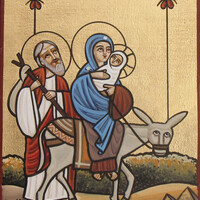
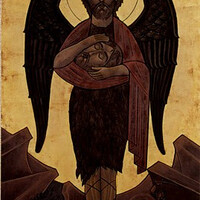
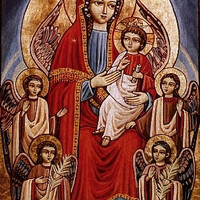
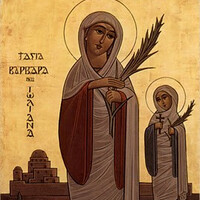
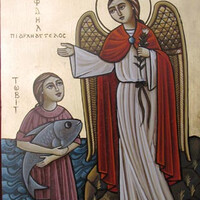
Starting from the 4th century, the Church began to decorate the walls of temples with frescoes and icons. In Coptic art, signs of a specific Coptic style begin to appear: the eyes and ears become larger in comparison with the proportions of the entire face, the mouth becomes smaller, and the size of the head in comparison with the body increases — which is a sign of spiritual relationship with God and devotion to prayer. The faces of martyrs are usually full of serenity.
Most Coptic icon painters did not sign their works. Tradition names the evangelist Luke (the first icon painter) and two Coptic patriarchs — Macarius I and Gabriel III of Alexandria.
Egyptian Christians believe that the art of icon painting was born in Egypt and like to compare ancient Egyptian painting with icons, listing the features of similarity.
The New Coptic School of Icon Painting
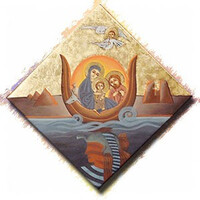
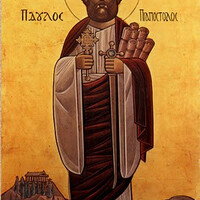
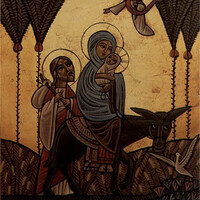
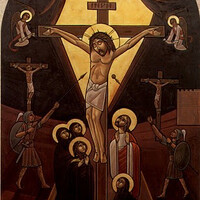
Modern Coptic art is also known as the neo-Coptic school. In certain periods of Coptic history, icons were the main means of expression. They preserved most of the traditional aspects. The main principles are greater concern for religious truth and beauty than for realism, or the depiction of depth and perspective. As in Byzantium and related traditions, icons are painted frontally, looking directly at the viewer.
The school took shape in the 1960s, based on the styles and traditions characteristic of icons of the 3rd–7th centuries. The masters of this early school of icon painting paid special attention to carefully painting the eyes of the saints, which are directed not at the worshippers, but into a distance known only to them. At the same time, they avoided excessive details and ornamentation in every possible way, showing the faithful only those details that are necessary for understanding the image.